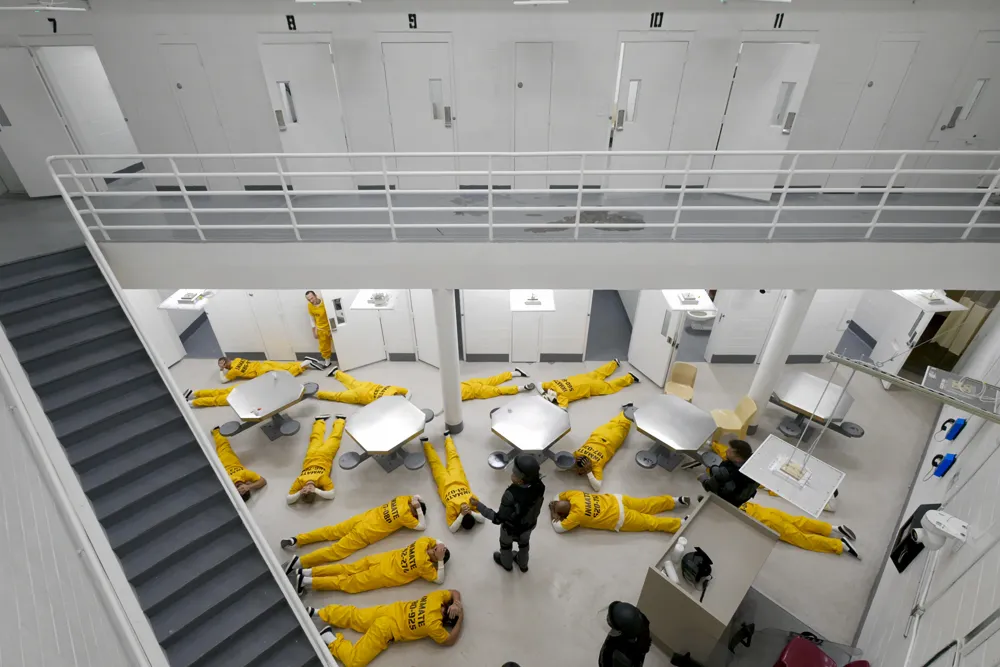
The New Stanford Prison Experiment premieres on Netflix on October 21, 2026, as a six-episode unscripted series, and like every Netflix original it will be available in the United States the moment it unlocks — roughly 12:00 a.m. PT / 3:00 a.m. ET on release day. One thing to know going in: despite the academic name, this is a reality series, not a documentary.
Netflix is reviving one of the most notorious — and most heavily criticized — studies in the history of psychology, restaging the 1971 Stanford setup as a controlled television format. Here is when it drops, how to watch it, and what the show actually is.
Release date and start time
The New Stanford Prison Experiment arrives October 21st on Netflix. New originals unlock at midnight Pacific, so expect all six episodes to be available at 12:00 a.m. PT / 3:00 a.m. ET on October 21. Each episode runs about 45 minutes, making the full season a roughly four-and-a-half-hour binge.
Where to watch it — and what it costs
The series streams exclusively on Netflix in the United States. Current U.S. pricing:
- Standard with ads — $8.99 per month
- Standard (ad-free, two devices) — $19.99 per month
- Premium (ad-free, four devices, 4K Ultra HD and HDR) — $26.99 per month
What is the show?
According to Netflix’s official synopsis, thirty willing participants enter a real prison and are randomly assigned to be either guards or prisoners. Dropped into a system built on hierarchy, control, and raw power dynamics, they become the test of a deliberately uncomfortable question: do ordinary people inevitably conform to the role they are handed, or can empathy, morality, and individuality hold out against the pressure of the group? As the days pass, the balance of power shifts and the tension escalates — which is, of course, exactly what Netflix is counting on. The series is produced by Jane Lipsitz, a veteran of large-scale unscripted television.
It is worth repeating that this is an unscripted reality series, not a documentary. It does not re-examine the 1971 study through archival footage and interviews; it stages a brand-new version of the scenario with new participants for the cameras.
Netflix frames the restaging as a controlled one, and the distinction matters given the original experiment’s history. The 1971 version had no meaningful oversight once it began, which is a large part of why it spiraled and had to be shut down. A modern production filming thirty people inside a real prison for a streaming audience operates under a very different set of duty-of-care, consent, and safety expectations — and how visibly the show honors those expectations on screen will be one of the things viewers and critics scrutinize hardest.
The controversy it is built on
The original Stanford Prison Experiment was run in 1971 by psychologist Philip Zimbardo, who cast college students as guards and inmates in a mock jail in the basement of a Stanford University building. It was cut short after six days when the “guards” turned abusive, and for decades it was taught as proof that situation and role can override individual character. In recent years, however, the study’s methods and conclusions have been heavily challenged — critics argue participants were coached, that key behavior was exaggerated, and that its famous findings do not hold up as science. Netflix restaging the scenario as entertainment has already drawn ethical objections, and that debate is likely to follow the show.
The 1971 study was dramatized in the 2015 feature film The Stanford Prison Experiment; its trailer is a quick primer on the setup Netflix is reviving:
Netflix has done this before
If the premise sounds familiar, that is because Netflix explored nearly identical territory in 2024 with Unlocked: A Jail Experiment, which placed real inmates and a loosened set of rules inside an actual county jail. That show is the closest reference point for the tone and format this new series is likely to adopt, and its trailer gives a fair sense of what to expect:
Should you watch?
If you are drawn to high-pressure social experiments and the “what would I actually do?” tension they generate, this will be an easy add to your October queue. If the ethics of turning a discredited, harm-linked study into competitive reality television bother you, that reaction is shared by a good number of critics — and it may be the most interesting conversation the show produces.
Frequently asked
When does The New Stanford Prison Experiment come out?
October 21, 2026, on Netflix.
What time can I watch it?
Around 12:00 a.m. PT / 3:00 a.m. ET on October 21, following Netflix’s standard midnight-Pacific release.
How many episodes are there?
Six, each running about 45 minutes, all released at once.
Is it a documentary?
No. It is an unscripted reality series that restages the experiment with new participants, not a documentary about the 1971 study.
How much does it cost to watch?
Only a Netflix subscription, starting at $8.99 per month for Standard with ads.
Is the original experiment considered valid?
Its methods and conclusions have been widely challenged in recent years, and many researchers no longer treat its findings as sound science.