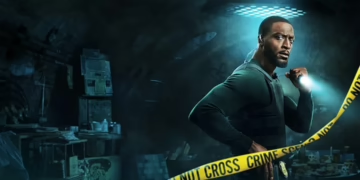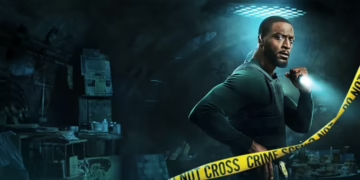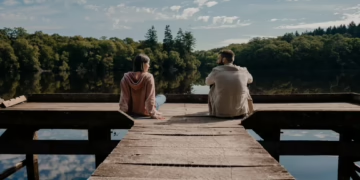
Released on January 30 on Prime Video, Wake (also known as “Vaka: the awakened”) wastes no time making an impact. In just a short span, this six-part drama has surged into the top tier of the most-watched shows, driven by a chillingly simple idea: what happens to a modern city when people suddenly stop sleeping?
Insomnia as a modern-day nightmare
Instead of leaning on complex scientific explanations, Wake focuses on the fallout of a mysterious insomnia epidemic. As more and more people lose the ability to sleep, everyday life unravels: public services struggle, fear spreads through the streets, and political leaders scramble to react in real time.
This approach turns the show into more than a genre piece. It sits at the crossroads of social drama and thriller, using a health crisis to explore how institutions, communities, and individuals respond when the basic rules of life no longer apply.
Directed by Henrik Georgsson, known for his work on The Bridge, the series builds tension not through jump scares, but through the slow erosion of sanity, order, and trust.
A YouTube preview to set the tone
Get a sense of the atmosphere and the stakes with this preview:
A crisis story told through multiple lives
Rather than following a single hero, Wake embraces a multi-character structure to show how the insomnia crisis cuts across every layer of society. Among the key perspectives:
- a disgraced government minister suddenly pulled back into the spotlight when the emergency spirals out of control,
- an ER nurse willing to cross lines to protect the man she loves,
- ordinary citizens trying—and often failing—to hold on to a normal routine as their world destabilizes.
Actors Jonas Karlsson and Aliette Opheim help anchor the story with grounded, restrained performances. The city that surrounds them feels familiar at first, then gradually turns alien, mirroring the characters’ mental and emotional exhaustion.
How critics reacted to the series
The critical response to Wake has been mixed but engaged. Reviewers have highlighted the show’s ambition and its suffocating, anxiety-inducing atmosphere. At the same time, some have pointed to a storytelling style that can feel fragmented or uneven.
One element that frequently stands out is the political angle: the way the show portrays tensions at the top of the state, tough decisions made under pressure, and the struggle to maintain legitimacy when every choice is made in crisis mode.
Despite those divided opinions, audience curiosity has remained strong. Viewers drawn to Nordic-style dramas and large-scale crisis narratives are finding plenty to latch onto, especially on global streaming platforms like Prime Video.
Why this insomnia drama works so well on Prime Video
Wake taps into several trends that tend to perform well with US streaming audiences:
- stories about societies destabilized by an invisible, hard-to-contain phenomenon,
- a focus on political and institutional responses rather than just individual survival,
- a compact format that favors intensity and suspense over exhaustive explanations.
Across six episodes, the series delivers a concentrated viewing experience. It doesn’t aim to neatly wrap up every mystery; instead, it leans into the emotional and human cost of a crisis that no one fully understands or controls.
For viewers in the United States looking for a grounded, character-driven dystopia on Prime Video, Wake offers exactly that: a speculative nightmare built out of very recognizable social and political dynamics.
Key facts to know before you start watching
If you are considering adding Wake to your watchlist, here are the essentials:
- The show is built entirely on a fictional premise, but it leans on believable social and political mechanisms.
- Season one is short and bingeable, with exactly six episodes available at once on Prime Video.
- It is produced in its country of origin and filmed on location, featuring a cast made up primarily of Scandinavian actors.
FAQ
Is Wake based on a true story?
No. The series is a work of fiction. However, it draws on realistic social and political reactions to a large-scale crisis, which gives the story a grounded, believable edge even within its speculative premise.
How many episodes does Wake have on Prime Video?
Wake consists of six episodes, all released at the same time on Prime Video, making it easy to watch over a weekend.
Where was Wake produced and filmed?
The show is a production from its original European country, shot in Stockholm and performed mostly by Scandinavian actors, which contributes to its specific visual and cultural tone.
What makes Wake different from other dystopian shows?
Instead of focusing on special effects or heavy worldbuilding, Wake zeroes in on the psychological strain, the breakdown of everyday services, and the political fallout of an insomnia epidemic. Its short, tense format emphasizes human consequences over clear-cut resolutions.