On January 20, a major broadcast event will turn the spotlight on one of the defining issues of our time: how war, fragile alliances and shifting power dynamics are reshaping the global order. Across one evening, viewers are invited to follow live political debates and an original documentary, all centered on a single question: what do current conflicts and the foreign policy of Donald Trump mean for the future of the Western world?
The night unfolds in several acts: an in-depth political conversation in prime time, a feature-length documentary titled War, Donald Trump and Us, and a late-night debate with international affairs experts, capped by a second documentary. The goal is not just to relay breaking news, but to make sense of how decisions taken in centers of power reverberate far beyond the battlefield.
Live political debate: setting the stage for a world in crisis
The special begins right after the evening news, with a live political debate hosted by journalist Caroline Roux. This opening segment is designed to frame the broader discussion: what kind of world are we living in when long-standing balances of power are being tested, alliances are strained and diplomatic tensions keep escalating?
Caroline Roux will first speak with Jean-Noël Barrot, Minister for Europe and Foreign Affairs, then with Jean-Luc Mélenchon, leader of La France insoumise. Their back-to-back interviews focus on a few core themes: the state of transatlantic cooperation, competition between global powers and how their country positions itself amid a fast-changing geopolitical landscape.
Rather than staying at the level of abstract theory, the conversation aims to connect policy choices to concrete realities: the war at Europe’s doorstep, the impact of unpredictable decision-making in Washington, and the long-term consequences for global security.
The centerpiece: a new documentary on a Europe under pressure
At 9:10 p.m., the evening pivots to its central feature: the premiere of War, Donald Trump and Us, a 100-minute documentary directed by Guy Lagache. The film follows on from an earlier work, A President, Europe and the War, which was shot four years earlier at the heart of the country’s diplomatic apparatus.
This new documentary portrays 2025 as a turning point for Europe. At that moment, a devastating armed conflict on Europe’s borders has already taken a staggering human toll, with more than one and a half million people killed or injured. Against this backdrop, the film examines a slow but deep rupture with the United States under Donald Trump, whose unpredictable diplomatic posture undermines long-standing alliances in the face of Vladimir Putin’s Russia.
Viewers are immersed in a landscape of hybrid warfare: sabotage operations, mysterious “ghost ships,” interference campaigns and drone overflights. The documentary raises an unsettling question: could these shadow conflicts escalate into a direct military clash between Europe and Russia? And if that happens, is the continent prepared to resist a predatory logic that might extend far beyond Ukraine?
Inside high-stakes diplomacy: from presidential teams to global summits
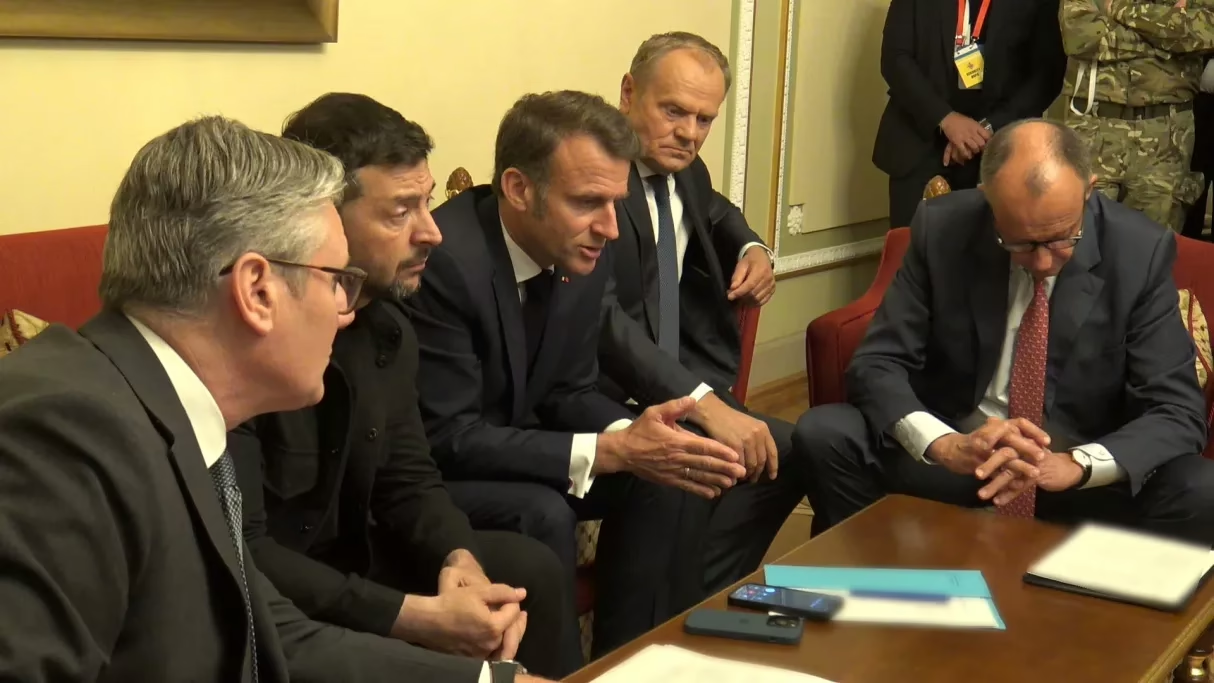
One of the distinctive strengths of War, Donald Trump and Us is its access. Guy Lagache follows the diplomatic teams surrounding President Emmanuel Macron, capturing exclusive footage of negotiations and exchanges with European allies. The camera travels from Paris to Kyiv, Berlin, London, Brussels and Washington, revealing how decisions are shaped in real time.
The documentary opens the doors to major international summits: G7 meetings, NATO gatherings, the Munich Security Conference and the delicate talks around American-backed peace plans. Rather than only showing the official photo ops, the film focuses on the corridors, side discussions and working sessions where strategies are contested and refined.
Through this behind-the-scenes perspective, viewers can see how leaders weigh risks, attempt to maintain unity and navigate the tension between national interests and collective security.
Political leaders and experts at the heart of the narrative
The film builds its story around interviews with numerous political and military figures and international experts. Among them are NATO leaders, European ministers, diplomats and seasoned journalists. Their testimonies help unpack the diplomatic showdowns and strategic choices that shape Europe’s response to war and pressure from rival powers.
These voices do not speak in unison; instead, they bring a range of perspectives on how to deal with Russia, how far to rely on the United States under Donald Trump, and what options remain when escalation seems always one step away. Together, they offer a multi-layered reading of a world sliding back into power politics and spheres of influence.
Late-night analysis and a second documentary
After the feature documentary, the special continues at 10:50 p.m. with another live debate moderated by Caroline Roux. This time, she brings together experts in international relations to dissect the return of imperial logics and assess how much room for maneuver a country like theirs still has in the emerging world order.
The conversation extends the questions posed by the film: What does security mean in an era of hybrid warfare? How can a mid-sized power defend its interests while staying committed to multilateralism? And what kind of strategic vision is needed when institutions, alliances and norms are under strain?
At 11:45 p.m., the channel also airs the documentary Greenland, Annex Me If You Can, directed by Walid Berrissoul. This second film closes out an evening built to push viewers beyond headlines and into the structural forces that could define Europe’s future.
Why this special night matters for an American audience
While the programs focus on Europe, the stakes are anything but local. For viewers in the United States, the special offers an external look at the ripple effects of U.S. foreign policy and the Trump era on allies and rivals alike. It underlines how shifts in Washington’s posture influence not only military alliances, but also economic security and democratic resilience abroad.
The documentary’s exploration of transatlantic tensions, the fragility of trust and the rise of hybrid warfare resonates far beyond European capitals. In a world where U.S. elections and leadership changes can quickly alter global trajectories, this kind of in-depth reporting helps audiences understand how America’s choices are interpreted, contested and sometimes feared on the other side of the Atlantic.
Key details: schedule and host
- Broadcast date: the special airs on Tuesday, January 20, both on television and via a streaming platform.
- Main documentary: War, Donald Trump and Us, directed by Guy Lagache, is scheduled for 9:10 p.m. and runs for 100 minutes.
- Host: journalist Caroline Roux anchors all the live debate segments throughout the evening.
Overall, the programming is conceived as a deep dive into today’s geopolitical turmoil and the decisions that could shape the continent’s future in the years ahead.
FAQ
What is the central theme of the documentary “War, Donald Trump and Us”?
The film examines how, in 2025, a brutal war on Europe’s borders and a growing rift with the United States under Donald Trump combine to destabilize long-standing alliances and raise the risk of confrontation with Russia.
How does the special address the concept of hybrid warfare?
The documentary highlights forms of conflict that blur the line between war and peace, including sabotage, ghost ships, interference operations and drone overflights, showing how these tactics pressure Europe without open, declared war.
Who are the main political figures featured in the evening’s programming?
During the live debates, Caroline Roux interviews Jean-Noël Barrot, Minister for Europe and Foreign Affairs, and Jean-Luc Mélenchon, leader of La France insoumise. The documentary itself includes many political leaders, NATO officials, European ministers, diplomats and journalists.
Why is this broadcast relevant for viewers in the United States?
Because it offers a detailed view of how European leaders perceive U.S. foreign policy under Donald Trump, how that affects transatlantic cooperation and how global power struggles, from war in Europe to tensions with Russia, are deeply tied to American decisions on the world stage.