Beginning February 6, Netflix in the United States is rolling out a tense new drama titled Salvador. Blending family crisis and ideological conflict, the series follows a father forced to confront his daughter’s involvement with a violent neo-Nazi movement. Fronted by Luis Tosar and Claudia Salas, this eight-episode thriller uses an intimate family story to explore how extremist ideas can fracture homes and communities.
A family emergency collides with extremist violence
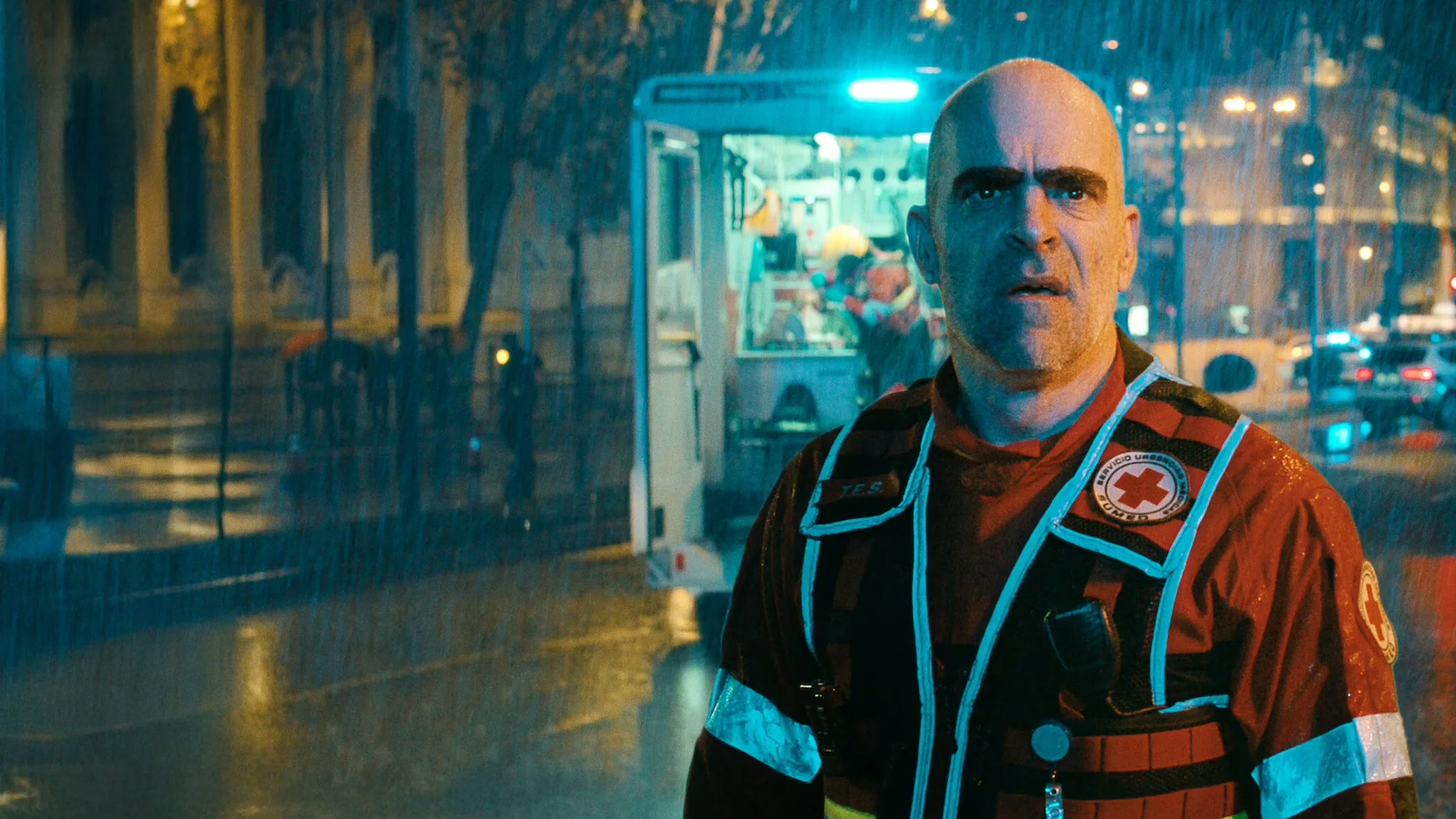
The starting point of Salvador is deliberately grounded and everyday. The show centers on Salvador Aguirre, an ambulance driver whose routine life is shattered after a brutal clash between rival ultra groups. Salvador is on duty at the scene, responding as a first responder during the organized brawl.
That same event exposes a devastating truth: his daughter Milena is involved with a neo-Nazi group. From that revelation on, the story stops being just about street violence and becomes a deeply personal race to understand how a young woman could be drawn into an ideology built on racism, homophobia, and aggression.
As Salvador digs deeper, he is pulled into a world where moral boundaries blur and easy answers disappear. The show raises questions that feel especially relevant for U.S. viewers in 2026: how does radicalization creep into everyday life, what happens when dialogue between generations breaks down, and why are extremist narratives finding new traction across contemporary societies?
A grounded thriller led by Luis Tosar and Claudia Salas
Salvador leans heavily on its cast to keep the story rooted in emotional reality rather than spectacle. Luis Tosar plays Salvador Aguirre as an ordinary man suddenly facing a situation completely beyond his control. Opposite him, Claudia Salas — known to many streaming fans from the series Élite — takes on the pivotal role of Milena, whose ideological shift drives the entire narrative.
The show also brings together a strong ensemble to flesh out both the private and institutional sides of the story:
- Leonor Watling
- Patricia Vico
- Fariba Sheikhan
- Candela Arestegui
- Andrés Gertrúdix
Through these characters, Salvador weaves a broader tapestry where family life, law enforcement, and ideological networks constantly intersect. The result is a portrait of a society struggling to respond when extremist beliefs move from the margins into the heart of a home.
Behind the camera: creators focused on social tension
The series is created by Aitor Gabilondo, a storyteller known for socially engaged dramas on Netflix. The scripts are written by Aitor Gabilondo, Joan Barbero, and Anna Casado, with direction by Daniel Calparsoro. Produced by Alea Media and filmed in Madrid, the show favors a realistic visual approach over flashy action, emphasizing the gradual descent of its main character into a universe he does not control.
This choice of style matters: by avoiding sensationalism, Salvador keeps attention on how radical ideas slowly infiltrate daily life. The camera follows Salvador step by step as he discovers how far the ideology threatening his daughter — and his family — has spread, forcing him to question what one individual can realistically do in the face of widening social fractures.
The first season of Salvador consists of eight episodes and is available to stream on Netflix starting February 6.
Fiction that echoes real-world social issues
Even though the characters and plot of Salvador are fictional, the themes it tackles are anything but abstract. The series draws on real social concerns: the rise of hate-fueled rhetoric, the mechanisms of recruitment into extremist groups, and the emotional fallout when political and ideological battles invade family spaces.
For U.S. audiences accustomed to seeing polarization and radicalization in the news cycle, the show offers a narrative lens on questions that feel very close to home: How do you keep communication open with someone drifting toward extremist beliefs? Where is the line between concern, intervention, and personal safety? And what happens when institutional responses don’t move fast enough to protect those most at risk?
FAQ
Is Salvador based on a true story?
No. The show is built around real social issues, but both the storyline and the characters are fictional.
How many episodes does the first season of Salvador have?
The first season includes a total of eight episodes.
Who is behind the creation of Salvador?
The series is created by Aitor Gabilondo, written by Aitor Gabilondo, Joan Barbero, and Anna Casado, and directed by Daniel Calparsoro.
Where can I watch Salvador in the United States?
The series is available for streaming on Netflix starting February 6.