Streaming subscribers in the United States looking for a tense, grounded drama will soon have a new limited series to add to their watchlist. Radioactive Emergency, arriving March 18 on Netflix, revisits a real nuclear contamination incident from the 1980s and turns it into a story about memory, institutional failure, and the invisible cost of a public health crisis.
What is Radioactive Emergency about?
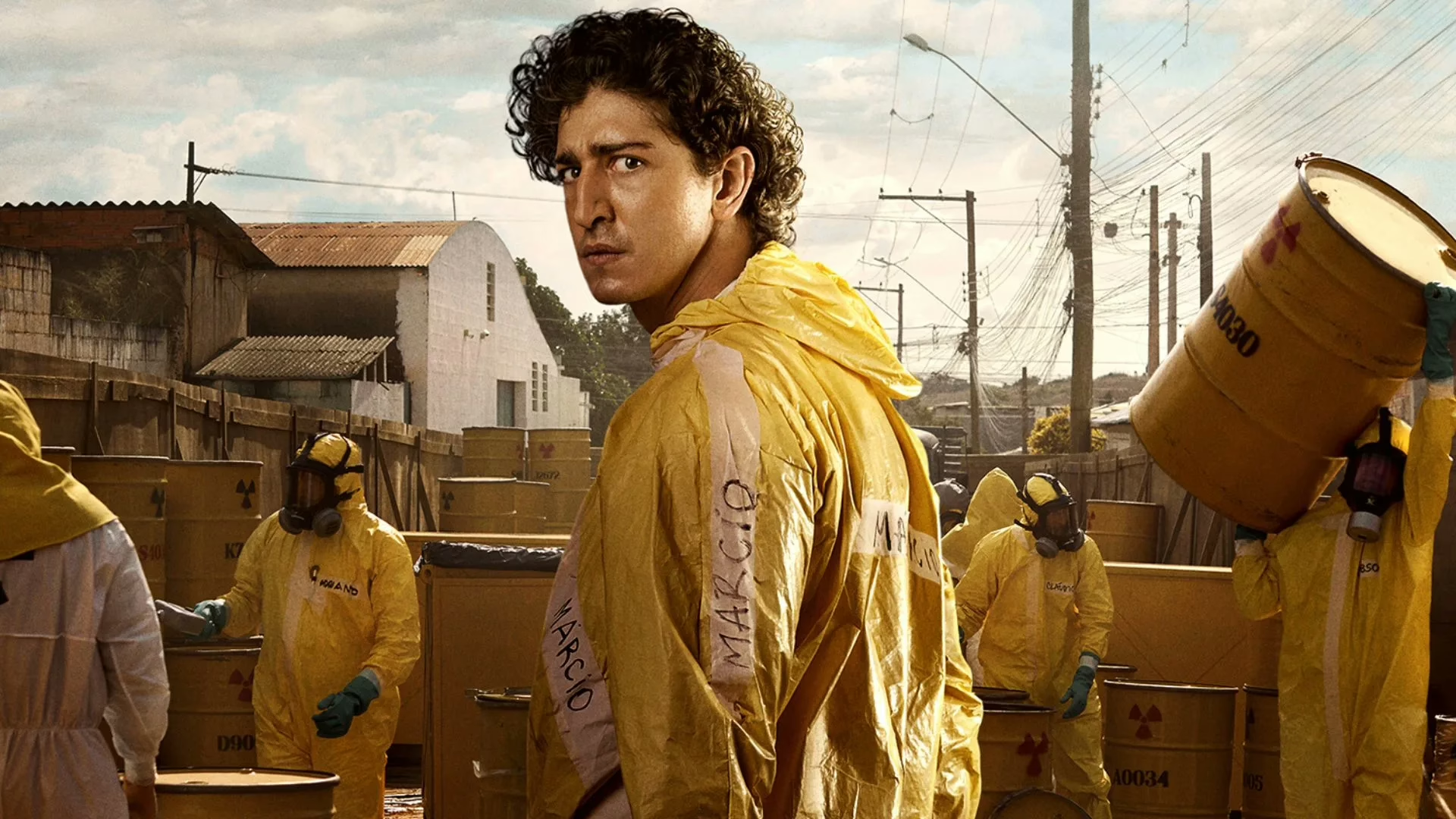
Instead of inventing a fictional disaster, the series draws on a documented event: the opening of an abandoned radiotherapy device that unleashed highly dangerous Cesium-137 in several neighborhoods. The show does not aim for a second-by-second reconstruction of the accident. Its focus is on what happens after the seal is broken—how contamination spreads through homes, workplaces and streets, and how long it takes for anyone to understand what is really going on.
Radioactive Emergency uses this incident as a way to explore the long shadow of a catastrophe that official narratives have often pushed to the margins. The series treats the event less as sensational spectacle and more as a collective trauma whose consequences linger for years.
A multi-perspective look at a nuclear crisis
Rather than following a single hero, the narrative weaves together several points of view to show how a disaster like this fractures an entire community. The series tracks:
- scientists who are urgently pulled in to measure and understand the scope of the radioactive contamination,
- political leaders forced to make high-stakes decisions that will define how the crisis is handled,
- families who are exposed without realizing the danger they are facing,
- ordinary workers who unexpectedly become some of the first and most vulnerable victims.
This structure places Radioactive Emergency alongside other socially minded dramas that are less interested in massive visual set pieces than in the complex web of social, institutional and personal reactions triggered by a catastrophe.
How the series builds tension and a sense of urgency
The direction by Fernando Coimbra leans into uncertainty instead of jump scares. The threat is never loud or obvious. Radiation spreads silently, out of sight, moving through objects, spaces and bodies long before anyone fully grasps the stakes. That invisibility becomes one of the main drivers of anxiety throughout the episodes.
Visually, Radioactive Emergency does not rely on nonstop spectacle or exaggerated disaster imagery. The storytelling escalates slowly, with the impression that every decision—from containment measures to communication with the public—arrives a little too late. That creeping feeling of delay and missed opportunities keeps the tension simmering and makes the show feel uncomfortably close to real-world crises.
The cast and its focus on collective experience
At the center of the ensemble is Johnny Massaro, whose role anchors the different narrative threads. Around him, a wide range of performers portray distinct segments of late-1980s society, from public officials to residents who suddenly find themselves in the middle of an unprecedented health emergency.
The presence of Leandra Leal and Emílio de Mello further reinforces the idea that no single character owns the narrative or controls the situation. The show deliberately avoids creating one omniscient protagonist. Instead, every character, whether publicly visible or seemingly anonymous, holds only a fragment of the truth.
A story about science, its power and its limits
One of the most striking aspects of Radioactive Emergency is the way it portrays scientists and medical professionals. The series highlights their central role in diagnosing and containing the disaster, but it also shows their doubts, constraints and blind spots. Science is depicted as indispensable, yet fundamentally dependent on resources, political choices and clear public communication.
This standpoint sets the show apart from more conventional heroic narratives. The people trying to manage the crisis are not portrayed as flawless saviors. They operate under intense pressure, with incomplete data and little time, while facing the fear and mistrust of a population that has not been properly informed. In that sense, the limited series uses fiction to ask uncomfortable questions about responsibility, transparency and how societies confront the irreversible.
When and where to watch Radioactive Emergency
The limited series will be available on Netflix starting March 18. For viewers in the United States interested in character-driven disaster stories—where memory, accountability and collective decision-making matter as much as the event itself—Radioactive Emergency promises to be a compelling addition to the streaming lineup.
FAQ
What is the main focus of Radioactive Emergency?
The series focuses on the aftermath of a real Cesium-137 contamination incident, looking at how institutions, scientists, political leaders and everyday people react to an invisible nuclear threat, rather than just recreating the accident itself.
Is Radioactive Emergency based on a true story?
Yes. The show is inspired by a documented event involving the opening of an abandoned radiotherapy device that released highly dangerous radioactive material into several neighborhoods.
How is the series different from typical disaster dramas?
Instead of relying on big visual effects, Radioactive Emergency emphasizes gradual tension, institutional decision-making, and the human cost of delayed responses. The danger is invisible and spreads silently, which shapes both the suspense and the emotional impact.
Who stars in Radioactive Emergency?
The central role is played by Johnny Massaro, with key performances from Leandra Leal and Emílio de Mello, among a broader ensemble cast that represents different parts of society affected by the disaster.