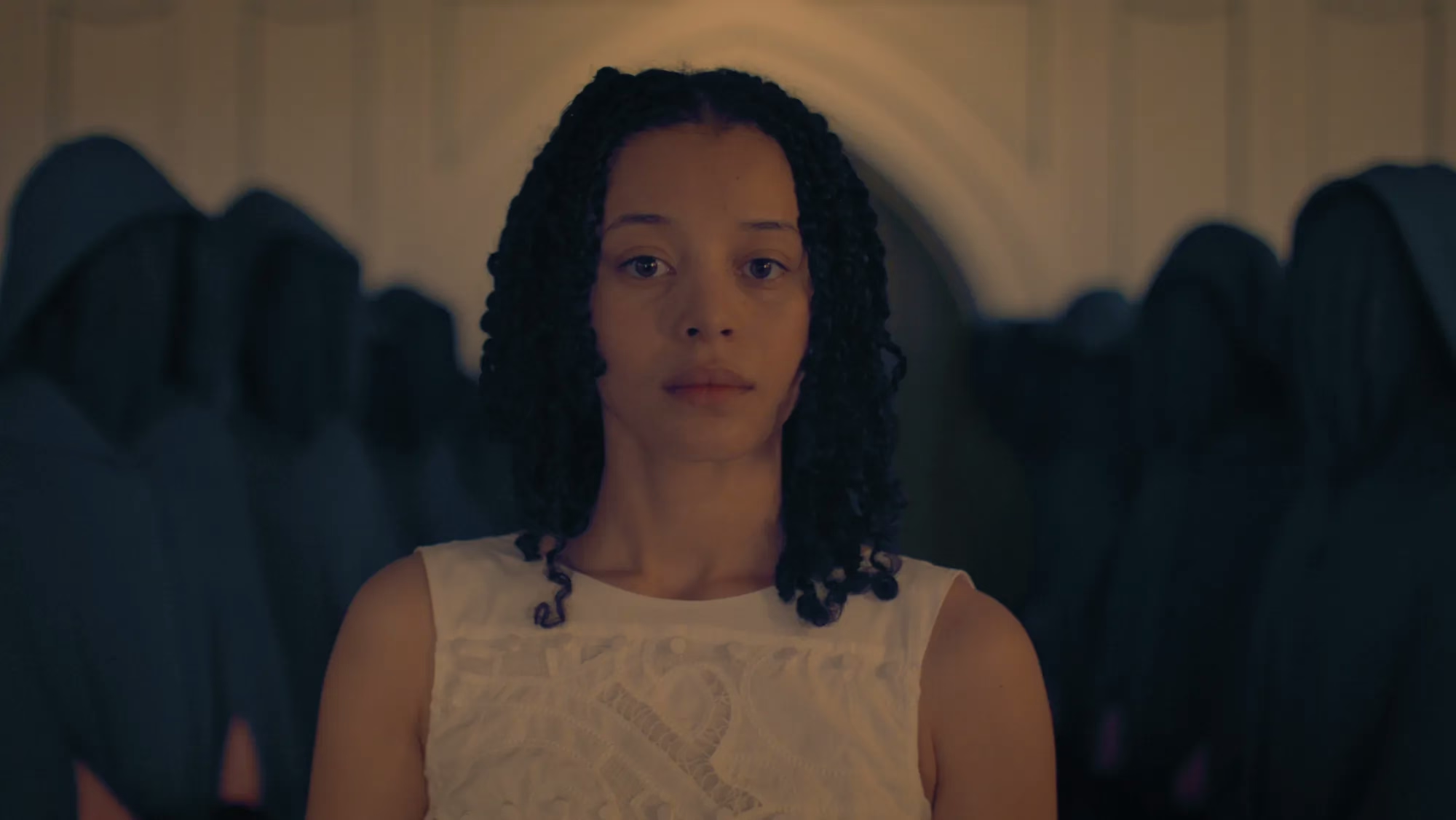
On April 8, Disney+ will debut The Testaments, a new drama series expanding the world introduced in The Handmaid’s Tale. Based on the novel of the same name by Margaret Atwood, this show returns to the oppressive regime of Gilead, but filters it through the eyes of a younger generation raised under, or suddenly exposed to, its ideology.
Adapted from Margaret Atwood’s novel, the series shifts the focus from the iconic characters of the original show to the institutions and generational dynamics that keep the system alive.
A new look at Gilead through two teenagers
The story of The Testaments unfolds several years after the events depicted in The Handmaid’s Tale. Instead of revisiting the same protagonists, the series places two teenage girls, Agnes and Daisy, at the center of the narrative, using their contrasting experiences to explore how a totalitarian order shapes minds and loyalties.
Agnes has never known anything other than Gilead. She has grown up inside the regime and has internalized its rules, beliefs, and rigid moral codes. For her, obedience is not just enforced; it feels like the natural order of things.
Daisy, on the other hand, comes to Gilead as an outsider. She encounters the country’s arbitrary laws and harsh social structure from the perspective of someone who is discovering it for the first time. The shock of this new reality highlights how strange—and violent—the system appears when you haven’t been raised to accept it.
Their paths converge when both arrive at a school run by Aunt Lydia. Officially, this school exists to provide moral and religious education. In practice, it relies on fear, coercion and guilt to produce absolute submission. What looks like a place of guidance is in fact a powerful tool for indoctrination.
By following Agnes and Daisy, The Testaments digs into questions that resonate strongly with audiences in the United States: how propaganda is taught, how loyalty is manufactured, and whether awakening and resistance are still possible when a regime leaves no room for dissent.
Creative continuity with The Handmaid’s Tale
The creative team behind The Testaments is designed to ensure strong continuity with the original series while still telling a self-contained story. Bruce Miller, who developed The Handmaid’s Tale for television, is also at the helm of this new show, supported by producers including Warren Littlefield, Elisabeth Moss and MGM Television.
This continuity promises a familiar thematic and visual universe: the same chilling theocracy, the same focus on power, control and moral justification. At the same time, The Testaments deliberately avoids simply repeating what viewers have already seen, opting instead to move the camera into the heart of the institutions that train, discipline and reproduce the ideology of Gilead.
Disney+ will release the first three episodes on April 8, giving viewers a substantial introduction to the new storyline and characters. After that initial drop, new episodes will arrive weekly, maintaining the kind of ongoing conversation and speculation that serialized storytelling thrives on.
The first episodes are directed by Mike Barker, who is responsible for establishing the show’s visual atmosphere and narrative rhythm. His work on these initial chapters lays the groundwork for this fresh tour through Gilead’s inner workings.
Institutions, control and the making of obedience
Rather than centering once again on the rebellion of already-formed adults, The Testaments zeroes in on the machinery that shapes the next generation. The school overseen by Aunt Lydia becomes a key setting: a place where young girls are taught to accept—and eventually perpetuate—the regime’s worldview.
The tension between what the school claims to be and what it actually is lies at the heart of the show. Outwardly, this institution appears to promote moral education and stability. In reality, it uses punishment, psychological pressure and strict discipline to eliminate any sense of personal autonomy.
Through Agnes, who arrives believing in the legitimacy of this system, and Daisy, who confronts it as an imposition, the series contrasts two paths into the same machine of control. The result is a layered look at how regimes maintain their grip not only through laws and violence, but also through education and the promise of belonging.
A cast built around power, authority and legacy
The Testaments brings back one of the most striking figures from the original series: Aunt Lydia, played by Ann Dowd. Once again, she embodies a central pillar of Gilead’s control structure, but now in a context where the focus is explicitly on transmission from one generation to the next.
Alongside her, Chase Infiniti and Lucy Halliday portray Agnes and Daisy, the two teenagers through whom the audience discovers this new chapter of the story. Their presence emphasizes the clash between indoctrination and awakening, belief and doubt.
The cast also includes Mabel Li, Amy Seimetz, Rowan Blanchard, Mattea Conforti and Zarrin Darnell-Martin. Together, this ensemble highlights female figures who are both agents and victims of authority, showing how power in Gilead is exercised, justified and handed down within a rigid, hierarchical structure.
By centering its cast on these dynamics of authority and inheritance, The Testaments reinforces its core theme: the survival of a repressive system depends as much on those who enforce its rules as on those who are forced to live under them.
A more intimate angle on a familiar dystopia
While it shares the same universe as The Handmaid’s Tale, The Testaments chooses a more intimate and initiatory angle. Instead of tracking large-scale resistance, the series concentrates on the inner fractures of a regime seen from the inside: the schoolroom, the family, the rituals of everyday life.
For viewers in the United States, this new show offers a chance to rediscover Gilead not as a distant nightmare, but as a system whose mechanisms—indoctrination, moral policing, institutional control—echo real-world concerns about how young people are shaped and controlled.
The series builds directly on the foundations laid by the earlier show, but it doesn’t simply continue the same storyline. By shifting the perspective to a younger generation and to the institutions that manage them, The Testaments opens up a fresh narrative space, one where learning, disobedience and the possibility of change collide.
FAQ
Is The Testaments a direct continuation of The Handmaid’s Tale?
The series takes place in the same universe and several years after the events of the original story, but it does not follow the same main characters. Instead, it introduces a new point of view focused on other figures and a younger generation.
How many episodes are released on Disney+ at launch?
Disney+ will make three episodes available on April 8. After that, one new episode will be released each week.
Do you need to watch The Handmaid’s Tale before starting The Testaments?
Knowing the original series helps you better understand the world of Gilead and its rules, but The Testaments is built as a standalone story with its own stakes and characters.
Which key characters and actors should viewers pay attention to?
Ann Dowd reprises her role as Aunt Lydia, a central authority figure in Gilead. Chase Infiniti and Lucy Halliday play Agnes and Daisy, the two teenagers at the heart of the story. The cast also includes Mabel Li, Amy Seimetz, Rowan Blanchard, Mattea Conforti and Zarrin Darnell-Martin, emphasizing the themes of power, transmission and control.